The first Mechanicus is frequently lauded in the same breath as games like Dawn of War as one of the first great video games in the Warhammer 40,000 universe. Despite the heaps of praise I’ve never gotten around to playing it myself, because while it’s right up my alley as a turn-based tactics game I really don’t care for the titular Adeptus Mechanicus (shortened to “Ad Mech” from here on out) much. Don’t get me wrong, they’re a fantastic faction in 40k for the sake of flavor and their red robes paired with intense cybernetics is an iconic look in the genre. I just don’t see the appeal of playing as the Imperium of Man’s engineers, especially since they don’t know how to change a light bulb without lighting up twelve incense burners and chanting for six hours. I much prefer the Necrons, the immortal robots and natural enemies of the Ad Mech that were your main enemies in Mechanicus. And wouldn’t you know it, clearly someone else agreed with me because in Mechanicus II you can play as both! Let’s see what all the fuss is about.
The core gameplay in Mechanicus II centers around “skirmishes,” battles in the game where you have a handful of units supported by a hero character and take on an opposing force with simple objectives ranging from “kill everything” to “survive X turns.” The combat is turn-based and while I’ll be making frequent comparisons to XCOM in this review the actual tempo of combat is more in line with The Banner Saga, if anyone reading this remembers those games. What that means is while “turn-based” in your XCOMs and Fire Emblems has you move all your units and then your opponent gets to move all their units, Mechanicus II has a back and forth system where in a perfect world where two armies have equal units you get to move a singular unit and then on your opponent’s turn they move a single unit.
The catch here is that while you can move any unit (that hasn’t moved yet that round) on your turn the enemy units always move on the same turns in a round, and if a given unit dies that faction loses its turn in the queue. For example if it’s a three-on-three battle there will be six turns in a round (1, 2, 3, 4, 5, 6), with you playing on odds and your opponent on evens. If you kill the unit playing on 4 there will then only be five turns in a round (1, 2, 3, 5, 6) with you now playing on “turns” 3 and 5 back to back. What this creates is an interesting dynamic of weighing taking down high priority targets (who are normally durable enough to last a round or two) versus my favorite tabletop RPG term “action economy;” clearing out weaker units first to reduce the damage potential of the opponent so you can worry about coordinating fire against larger targets on later turns. It’s a fun system though not 1:1 with Banner Saga, because if you are outnumbered the skirmish will see the enemy units getting multiple turns in a row until you thin the herd. Fortunately in those instances most enemies start out of weapons range so you can start picking off the outliers to make the turn balance a little more fair in the later rounds.
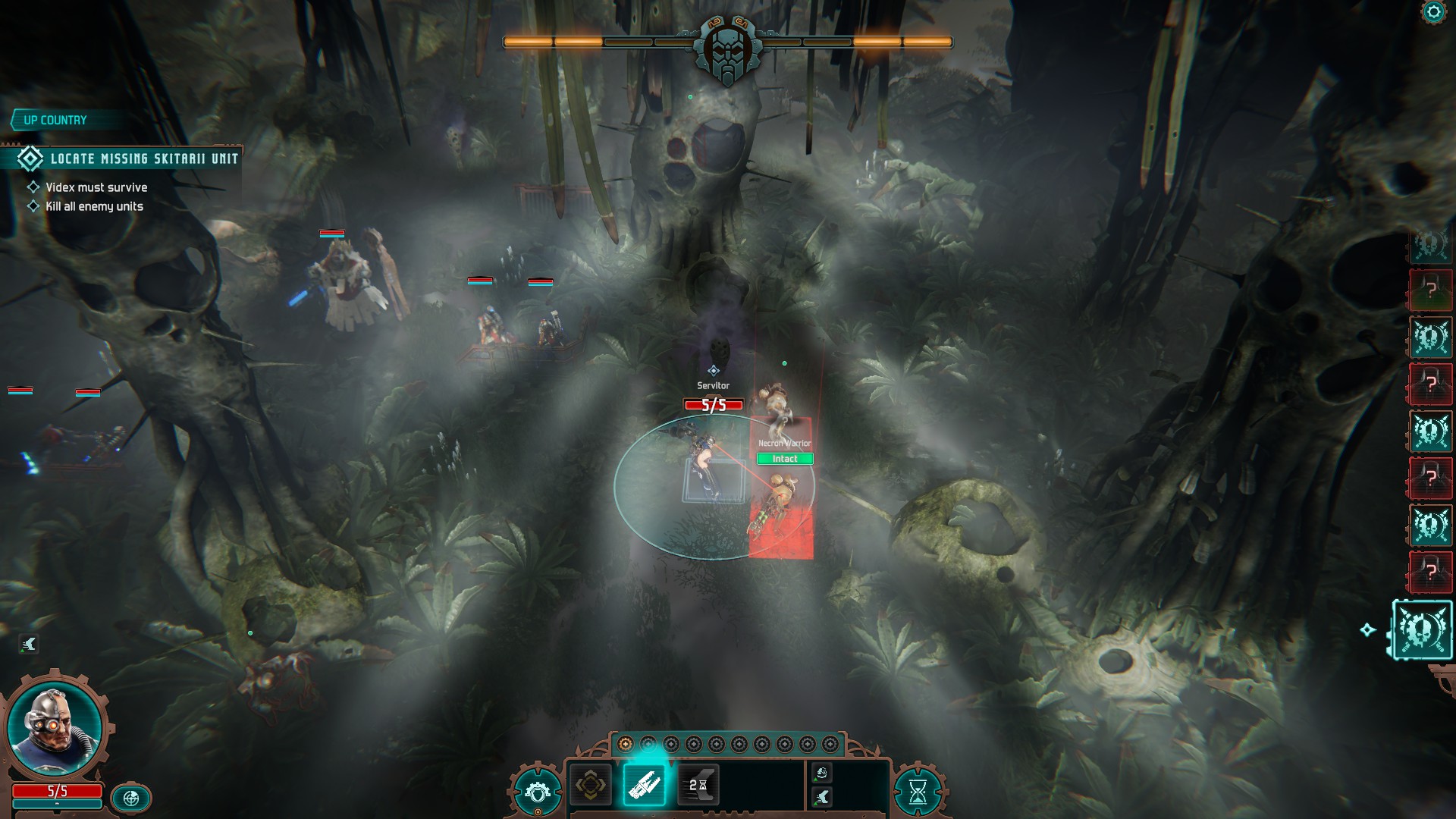
So the strategy elements are engaging but how does the combat feel? In a word it’s “fine,” following the same philosophy of XCOM with cover and sight lines, though if you attack something you are (usually) going to actually hit and damage it unlike XCOM’s much published percent chance to hit generator. This “guarantee” of damage along with seeing the entire battlefield and every enemy on it at the start of each skirmish means there’s very little in the way of surprises or changes of pace during Mechanicus II‘s battles, and I couldn’t help but feel like there’s something missing compared to other games with similar gameplay. If I may suggest something without meaning to sound pretentious, I think the missing element in Mechanicus II is the lack of “micro objectives” that play out throughout the course of a battle. In XCOM, for example, you have the option to take all sorts of aliens captive to further research, so every battle can be an opportunity to further optional game progress that isn’t being forced on you but is passively encouraged. Then there’s surprise ambushes, limited time rescues, timed objectives, etc, and Mechanicus II doesn’t really have that, as in every battle what you see is what you get and there are no mechanics encouraging going out of your way to do anything more than the basic objectives tell you.
We can get even more in the weeds though and say that every turn you play in XCOM is the micro objective of “stay in cover at all times.” You’re told (and shown) early on in XCOM that you need to always end your turn in cover lest the aliens appear out of nowhere and blast your defenseless soldiers to bits, so every soldiers turn innately has the “objective” to end in cover. While it isn’t something you’re forced to do it’s something in the back of your mind and affects how you view character movement when doing something as mundane as moving soldiers between combat encounters, even if you don’t realize it. Mechanicus II has nothing like this, as cover is few and far between and far less emphasized than in XCOM, so there’s really nothing to do but move towards the enemy, an enemy that you can always see, and either attack them or hope you’re not too out of position for the counter punch. It’s just a little too cut and dry for my liking in a strategy game, but I’m probably being too harsh.
Though when it comes to how your army selection works I’m not too worried about being too harsh. The Ad Mech and Necrons have different systems for dictating how you select your units for skirmishes, and I really can’t say I care for either of them. Each Necron leader has a “court” of preset soldiers that you can choose from before a mission begins, and each is allegedly built around the themes of the leader. One specializing in overwhelming ranged damage has snipers and AOE automatic weapons while another is almost all-in on melee with a bunch of bodyguards that give him bonuses, for example. The problem with this court system is that you have minimal ways to actually balance your party compared to something like XCOM where you could always (assuming they were alive) make sure you have a squad that can handle any situation. This means that you can find yourself completely blown out because you picked the wrong leader for a given mission as the Necrons, since the game doesn’t give you much information about the enemy types or map design of a mission before it begins. It’s rare when it happens but the possibility is there, and it’s not a fun experience when a strategy game that isn’t directly about discovering and overcoming the unknown undermines you with limited tools and information.
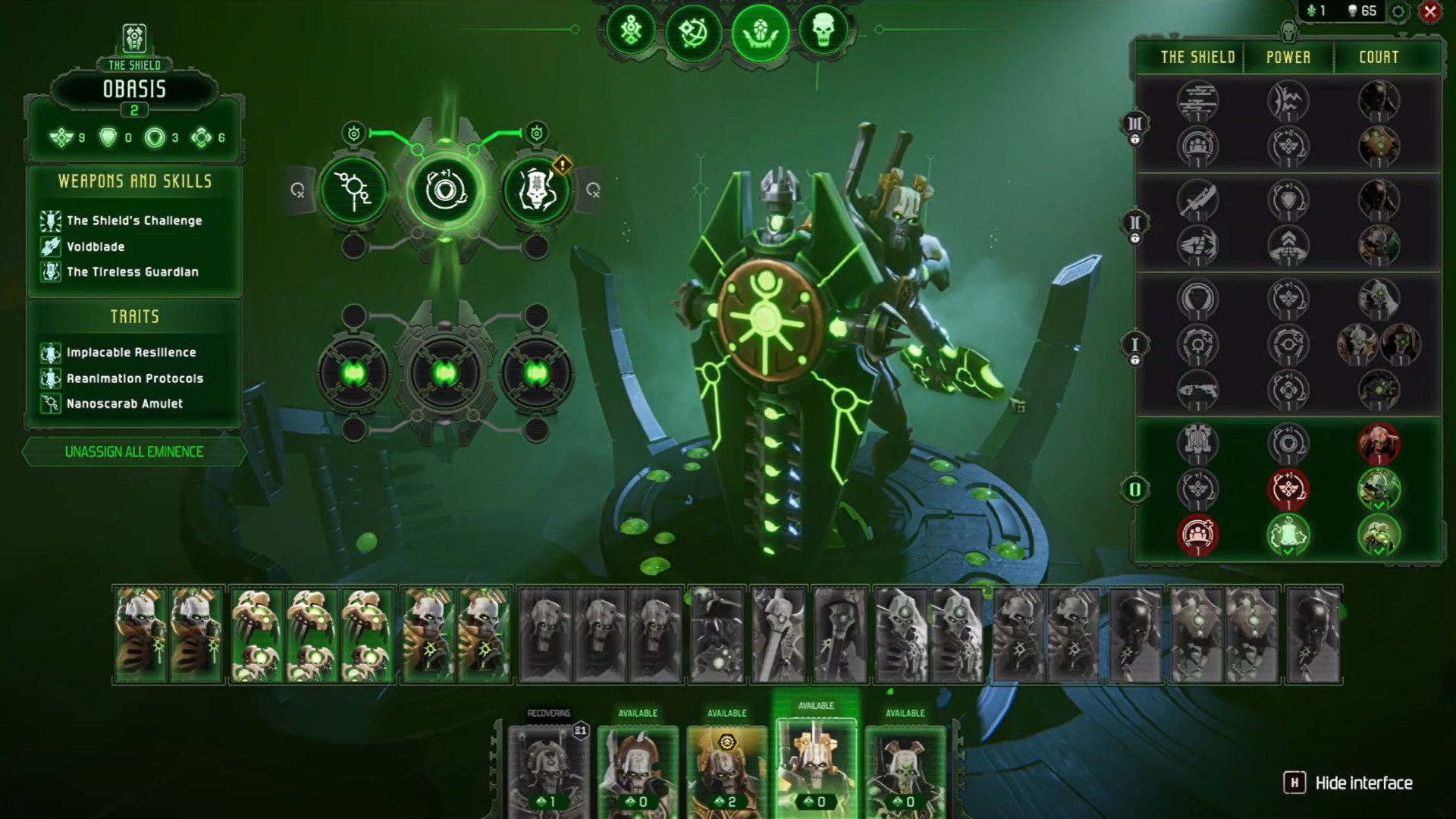
Something else that isn’t a fun experience is how the Ad Mech builds their armies for missions. Referred to as “clades” rather than courts, the Ad Mech leaders do not have a selection of eternal servants at their beck and a call but instead have to purchase the units they want to bring with them before every mission, using a fixed amount of resources that are generated by the temples on the map. The leaders themselves can apply some influence to this by reducing the cost of these purchases based on units that align with their design/playstyle, but what the leaders can rarely influence is which units are actually available for purchase. You read that right, if my complaints about the Necron’s courts are that the leaders present armies don’t offer enough variety then it’s even worse for the Ad Mech clades because your army selection mission by mission is a literal roll of the dice. Everything from the types of units to their weapons and stats, when applicable, are randomized before every mission, and it’s a real pain in the ass when you unlock powerful units or new weapons and then game just decides not to let you use them; especially during tough battles.
The only real way around this are the certain leaders that can guarantee a few units are in their clade for free at the start of each mission, but the randomization REALLY hurts both the play of the Ad Mech and how you progress as the faction. As the game moves forward you get the ability to unlock more and more units for your clade selection process, but there’s now the danger of unlocking units you don’t like. How do you know you don’t like the units? Well hopefully you played the Necron campaign first (which I don’t really recommend for story reasons, which we’ll get to later) to know what all the units do after you’ve fought them, because otherwise you’ll just have to unlock these units yourself and find out. Don’t like a unit? Whoops, you’re stuck with them showing up in your unit pool at the start of each mission, preventing you from buying the units you ACTUALLY WANT for the upcoming battle(s). When a game system actively punishes you for experimenting or engaging with their tech trees it feels like there’s a loss in the design process somewhere, especially considering how freely the game lets you reset leader upgrades in case you want to try something else but you’re set in stone for tech tree upgrades. On top of that when you do invest in units it’s not even entirely clear or fully explained what upgrades you’re unlocking as the tech tree just says “additional bonuses and abilities” that “may” be available because as I mentioned before your units upgrades are also randomized every time. And yes, you could make the argument that this is flavorful with the Ad Mech making bad technological investments into tech they don’t fully understand, but you could also argue that any piece of media is bad on purpose if you really wanted to and there’s only so much leeway I’m willing to provide.
Leaders also have their own progression system alongside the unit tech trees. Sending leaders on missions or to do passive side activities in the background gives you experience points and resources that can be used to unlock passive and active upgrades for both your leaders and the units in their courts/clades. The units don’t lose upgrades when they die so you can feel free to empower whatever you like and throw it face first into the meat grinder, which is rather freeing. My one complaint would be that the upgrades themselves don’t have as much impact as you my expect in the short term, especially for Ad Mech units due to the aforementioned vague as hell “getting additional bonuses.” Necron leaders unlocking new units through their leveling tree will inevitably improve their courts, but other passives like +1 health or your leader not provoking opportunity attacks feel less exciting in the moment to moment. This is especially true if you’re chasing an upgrade in the mid to high levels of their tree, like new weapons for your leader to use, but you know they’re over six missions away (minimum) in terms of experience requirements.
I’ve been avoiding an elephant in the room for long enough, an elephant that is one of the main reasons Mechanicus II is currently sitting at a “mixed” review score on Steam. The first Mechanicus had a dungeon traversal system similar to the first Darkest Dungeon, with the Ad Mech entering Necron tombs and having a limited amount of time to traverse a map marked with points of interest. It was up to the player to choose which rooms to explore with the time allowed and created a very “smash and grab, press your luck” sort of atmosphere that was very flavorful to what the Ad Mech generally end up doing when they find a Necron tomb. How much will you risk to find super secret technology? Well in Mechanicus II the answer to that is “nothing” because they have completely removed this mechanic, where now between skirmishes and events you simply watch a model of the leader in your army slowly walking across a map.
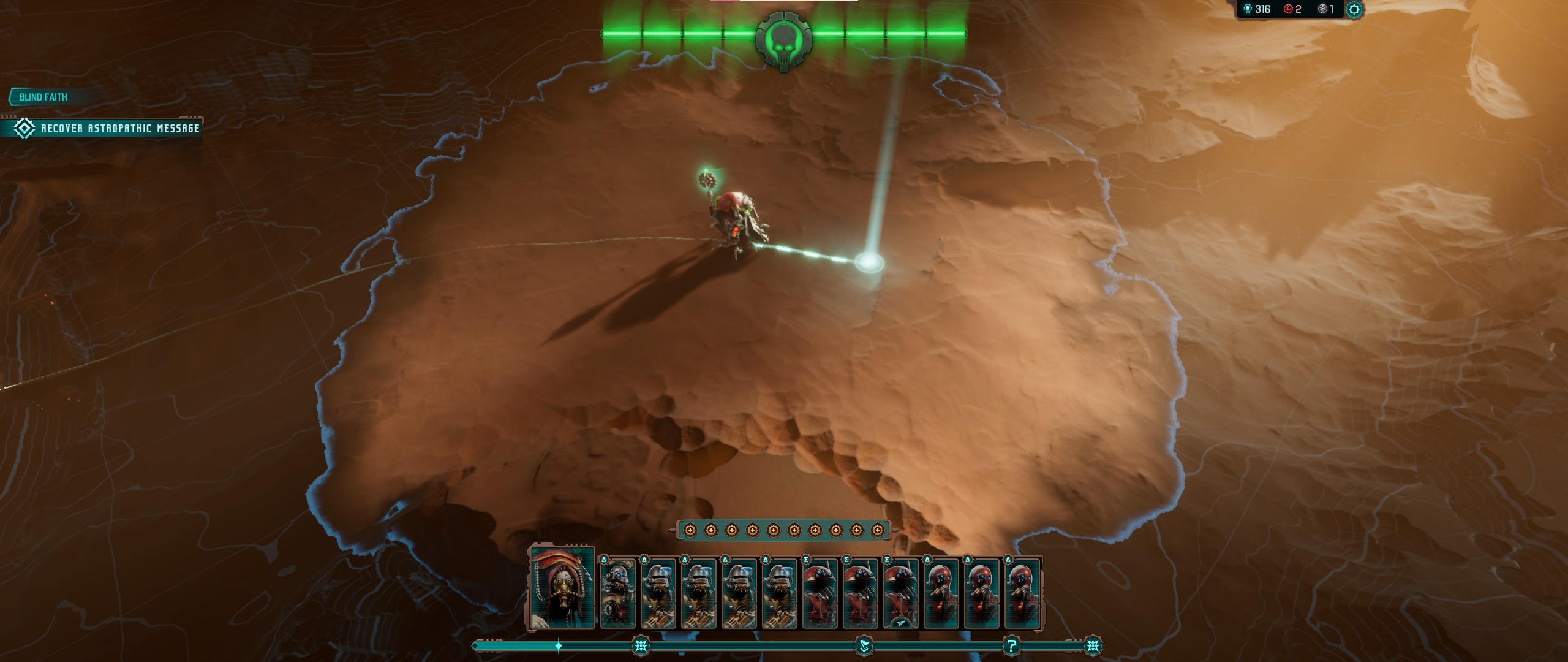
The reason I haven’t talked about this until now is that on a whole it doesn’t bother me as much as everyone else because I never played the first game. I do appreciate why fans of the original are upset about this change and once you know it’s missing the absence feels rather obvious, since there is very little going on during these travel segments without the exploration elements from the first game. This isn’t like Banner Saga where you have interesting/ominous scenery or the quaint appearance of your named soldiers in the vanguard, this is one guy walking in a pre-drawn line from point A to point B while a progress bar shows you when the next battle, point of interest, or conversation will happen. The latter is especially egregious because that means there’s very little unexpected in these travel sections, so in many ways they really only exist to make reference to a much more engaging feature that doesn’t exist. But again, without having played the first game you wouldn’t notice it’s gone, and it appears the developers sacrificed them for the sake of having a more narratively-driven experience. Personally I think there could have been room for both, but what do I know.
Said narrative is split between the Necron and Ad Mech points of view and it hits all the usual checkpoints of a story with these factions. The Ad Mech are in over their heads to a massive degree but are in denial about it as one of their own is a little too excited about the idea of Necron technology, while the Necrons devolve into political in-fighting almost immediately when their ruler predictably wakes up with dementia. This is all presented through some excellent voicework all around and the occasional cutscene, though most of it is told through character stills and dialogue boxes. There are both optional missions and a “critical path” to follow if you just want to push through the story, but if you want to do everything each campaign can last well over forty hours. The worst thing that can be said about the story is that it doesn’t do anything incredibly surprising or interesting beyond what you would expect from a traditional story with both these factions. It’s also a little weird that both campaigns appear to be “canon,” as they frequently show the same events from different sides, but the campaigns also have you killing the other side’s playable characters as the story goes on. I don’t hate it since this is a common enough feature in campaigns played from opposite perspectives, but it almost feels like an oversight if you’re truly presenting this as two sides of the same war.
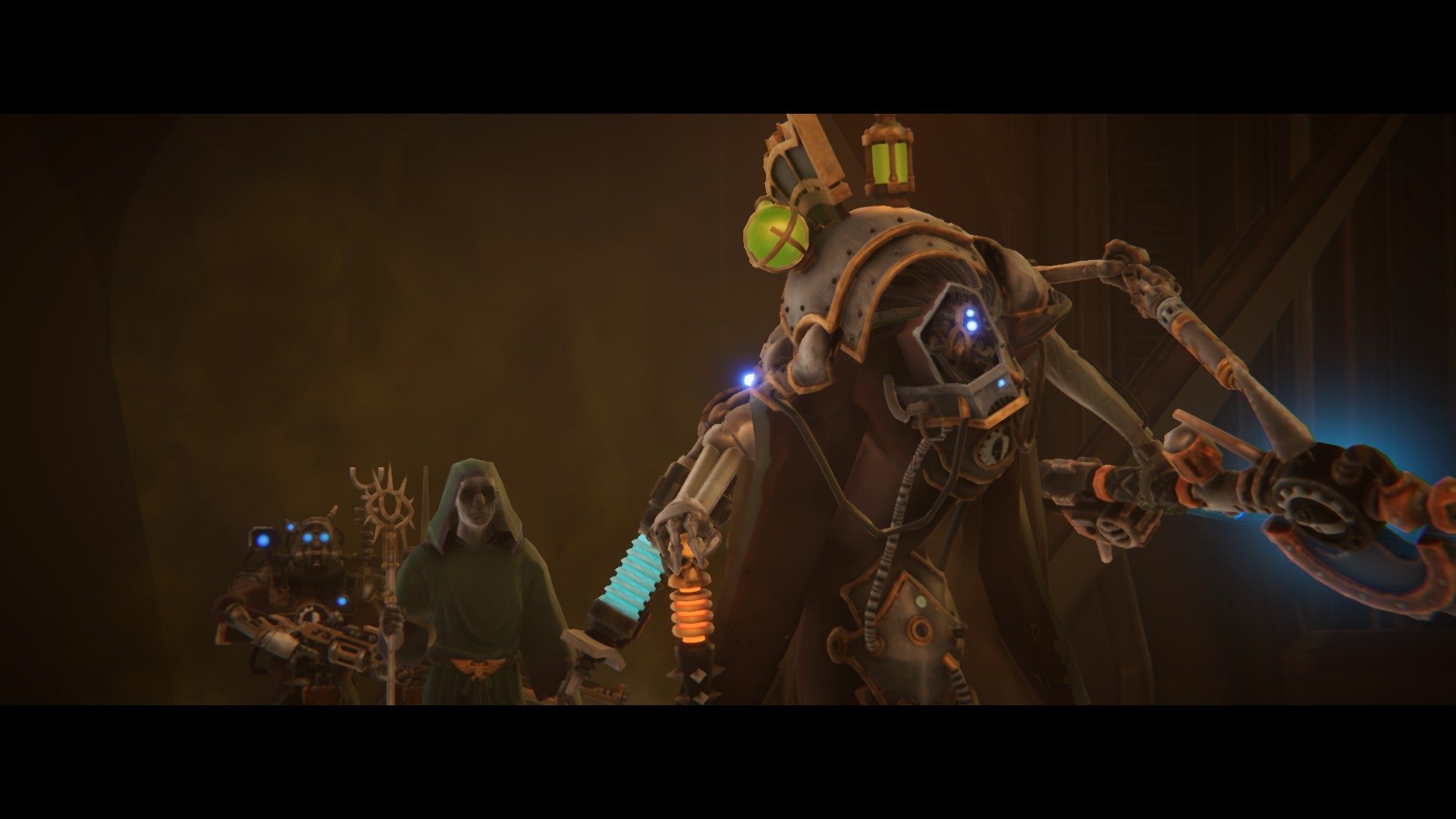
I will say it was hard to play both campaigns and not feel like the Necrons side of the game was a bit of an afterthought, or at the very least a campaign designed to be played second. The back half of the Necrons story is a lot of “here’s what was going on behind the scenes,” which makes it very hard to feel like a fulfilling narrative if all of the big moments are happening off screen in a different campaign. The finale feels like it comes out of nowhere if you play the Necrons first, and on top of that the Ad Mech campaign is just more fleshed out thanks to more cutscenes and other factors that just make the Ad Mech feel more involved. Ad Mech’s leaders are their own characters with their own personalities, dialogue in mission briefings, and unique designs/abilities, while the Necron leaders are just five samey looking robots that never appear during cutscenes and share at least one of their abilities with another leader. Obviously a big thing with the Necrons as a faction is some amount of uniformity and lack of (visible) unique features outside of the highest echelons of their forces, but with these being lords of a dynasty and the plot being about political machinations I think having a few other Necron characters wouldn’t have gone amiss. The Ad Mech gameplay itself also feels like it got more love, with more mission variety and also more common difficulty spikes than the Necrons. Individual Ad Mech units also call for a lot more active decision making during combat, since their abilities use a consumable resource while the Necrons units just kind of exist. It’s another great flavor win but there’s a disparity here that makes it hard to shake the idea that one faction got more love than the other.
Another thing that feels like it might have been a bit of an afterthought is the developers optimizing the damn game. Mechanicus II will turn your desktop into a jet engine without provocation or even a clear reason, such as during the bland, borderline scripted scenes of your leader walking through the map. This is a game that looks worse than both Helldivers 2 and Baldur’s Gate 3 and it makes my computer run worse than either of them. Maybe it’s the decent lighting and particle effects that are the problem? The game also can be played in a pseudo “detective mode” with the map stripped down to just the essentials while cool data strands flow across the screen, maybe that’s constantly running in the background? It could have also stood to have one more round of the most basic QA, because at time of writing the Necrons have a scene where they’re celebrating the destruction of an Ad Mech base but the subtitles are the Ad Mech celebrating destroying a Necron tomb. There are also at least two achievements that are glitched, which is a little ridiculous considering one is as simple as “get max resources” with a given leader (this has since been patched). While they were at ignoring the QA for subtitles and achievement unlocks they could have tweaked the AI to be a little more opposed to friendly fire, as frequently enemy and friendly units with AOE attacks will just fire them off without a care in the world, and if they aren’t doing that they’re suffering from bizarre target prioritization. In one particularly memorable instance a powerful enemy assassin unit killed its own leader while using an AOE melee attack to try to kill one of my units next to it, thus winning the mission for me. Maybe he wanted to switch sides… Other times the AI can’t seem to decide if it wants to kill regenerating disabled Necron units or attack active ones on the other side of the map. Either strategy has its own merits but when the AI can’t seem to stick to a plan itself it starts getting noticeable. These issues combined with the unnecessarily heavy hardware usage can make the game feel sloppy at times, though the overall presentation package is still mostly positive.
Mechanicus II is an above average strategy game experience that is elevated by its Warhammer 40k coat of paint. Returning fans are going to be understandably upset by the removal of the exploration gameplay and everyone should raise an eyebrow about a game that looks like this making your computer sound like it’s trying to heat a two-story house, but with proper ventilation and an interest in 40k I think there’s a enough to like here to push through the games 60+ hours worth of content. The combat isn’t as engaging as XCOM and it’s not as pretty as Banner Saga, but the voice acting and atmosphere is great and if you like this sort of strategy genre you could do a lot worse, especially these days. That being said if you’re hungry for Warhammer 40k content in this genre I’d recommend Chaos Gate: Daemonhunters instead, unless you’re a really big Ad Mech or Necrons fan.